Dick Whittington Turn Again and Errant Servant
Dick Whittington – A Traditional English Tale
Streets paved with gilded, a cat with an appetite for mice, and a boyfriend whose luck turns around.
Dick Whittington
– A Tradition English Tale –
IN the reign of King Edward 3 there lived in Somersetshire a boy called Dick Whittington, whose male parent and mother had died when he was very young. The people where he lived were very poor, and he had very fiddling to eat, but he heard talk nearly the not bad urban center of London, which they said was and so rich and fine that all the folks there were bully ladies and gentlemen, and that the streets were all paved with gold. And as he grew older he made upwards his mind that he would somehow manage to go to London, where he could brand his fortune. One twenty-four hours there drove through the village a large wagon with a team of horses on its way to London. So he took courage and begged the wagoner to allow him come also. The wagoner was moved to compassion when he heard how badly off poor Dick was, so he told him he might come if he liked, and they set off together.
When he reached London he said good-good day to the wagoner, who gave him a groat on parting, and with this as his sole possession, Dick wandered here and there, wondering what he should try to do next, and bitterly disappointed to find that in the streets that he had expected to be paved with aureate he establish zippo merely mud and dirt.
Later he had spent the picayune he had and had gone hungry for two days he sat down to rest on the doorstep of a merchant's house in Leadenhall Street. Presently the cook, who was exceedingly bad-tempered, saw him, and threatened to boot him from the door.
Just and then the master of the house, Mr Fitzwarren, came abode from the Royal Exchange. When he noticed the boy in that location he asked him what he wanted, and and so told him that he must get away at one time. Dick tried to do so, but was and then faint from desire of food that he fell down again when he tried to stand. And so he told Mr Fitzwarren that he was a poor boy from the state, and that he would do whatever work that was given him, if only to get some food. The merchant felt sorry for him, and as he happened to desire a boy to assistance in the kitchen he ordered 1 of his servants to have him in, proverb what piece of work he should exist given to do. Then a good repast was fix before Dick, and yous may exist sure that he was very glad to see it.
Merely all was non by any ways easy and pleasant for him. The servants fabricated him a laughing-stock, and the bad-tempered cook ordered him to do innumerable jobs in the kitchen, threatening to pause his caput with her ladle if he did not do them apace enough.

Analogy by Arthur Rackham
Still, he got plenty to eat at present, and that was a change. And Miss Alice, his chief's daughter, seeing him in the kitchen, found some sometime dress for him that were amend than his poor rags, and gave orders to the melt and the other servants that he was to exist treated kindly.
So it was decided that he should stay, and a bed was made upwards for him in the garret.
Only he establish that the rats and mice in the garret were almost as troublesome by night equally the cook was by mean solar day. They ran over Dick Whittington's face, and disturbed him so with their squeaking and scratching that he was almost tempted to run away one time more.
Soon afterwards a merchant came to dinner, and equally information technology came on to rain very difficult he was invited to stay the night. In the morning Dick cleaned his shoes, and when he took them to the merchant he was given a penny for his trouble. A petty later, as he was going on an errand, he saw a woman with a cat under her arm. He asked her if she would sell it. She said that as it was a fine mouser she would not have less than sixpence. Only when Dick replied that a penny was all he had the woman let him have the cat.
He took the cat home, and hid her in his garret all day, for he was afraid that the cook would kill her if she was establish in the kitchen. He e'er saved scraps from his dinner to take upward to her, and at night she worked so well for her living that Whittington was troubled no more with rats and mice.
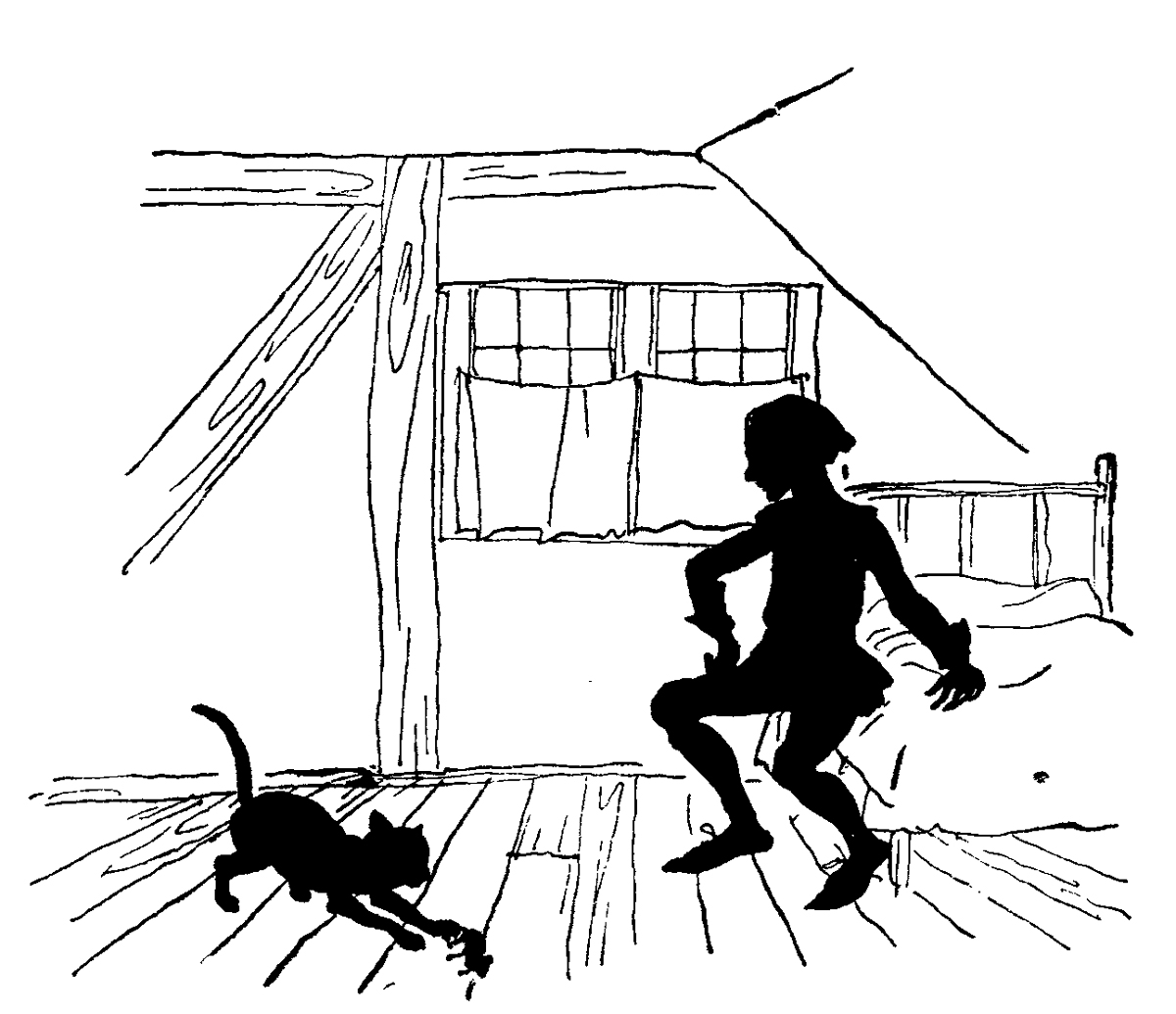
Illustration past Arthur Rackham
Now whenever the merchant, Mr Fitzwarren, sent out a ship it was his custom to call all his servants and ask them to venture something of their own in information technology. As he was at present sending out a transport everybody only Whittington came, and brought what they could for it. Miss Alice noticed his absence, and ordered him to exist called, only he tried to excuse himself, saying that all he could call his own was a poor cat which he had bought for a penny that had been given him for cleaning shoes. When Miss Alice heard this she offered to put something in the ship for him, but her father told her that it was the custom for everybody to venture something of his ain. He therefore told Whittington to bring his cat. This he did very unwillingly, for he was parting with his best friend. He had tears in his eyes as he gave it to the main of the transport, the Unicorn, which immediately started off down the river on her voyage.
After this the cook ofttimes made fun of Whittington's venture, and altogether she scolded and harassed him and so much that at concluding he fabricated up his mind to run away rather than exist and then tormented any longer. He packed up his package, and early the next morning got upward with the idea of going away into the state. He went through Moorfields, and in time he reached Holloway, where he sat downwards at the top of the hill to rest on a stone, which to this day is called "Whittington'southward Stone." Every bit he sat there he could hear Bow Bells ringing merrily. It seemed that they were speaking to him, and Maxim:
"Turn again, Whittington,
Thrice Lord Mayor of London."
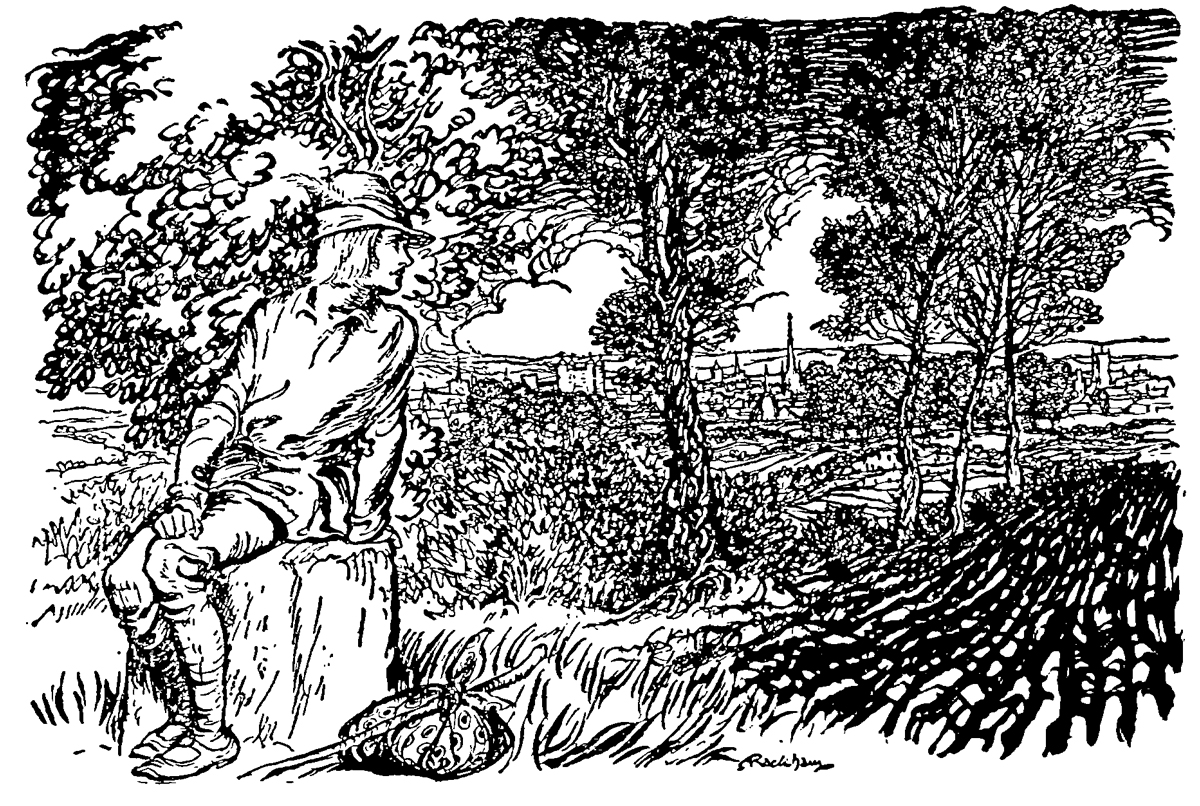
Illustration by John D. Batten
That seemed to him to be such a yard idea that he decided that he had better not run away later all. Every bit it was yet early he thought that he might achieve home before his absence was noticed. And so it happened. And he was able to creep rapidly in and start doing his usual work without being seen past anybody.
While all this was going on the transport in which Whittington's true cat had been taken, after having been buffeted by contrary winds, had sought shelter on the coast of Barbary. The inhabitants of this region were Moors, and they were quite unknown to the English. Equally they seemed tending to be friendly, however, the send'southward captain determined to trade with them. He brought all his wares on deck and displayed them and then that the Moors could see what he had. They were then pleased with the goods that news was carried to the King, who sent for samples and afterwards invited the master to come up to the palace.
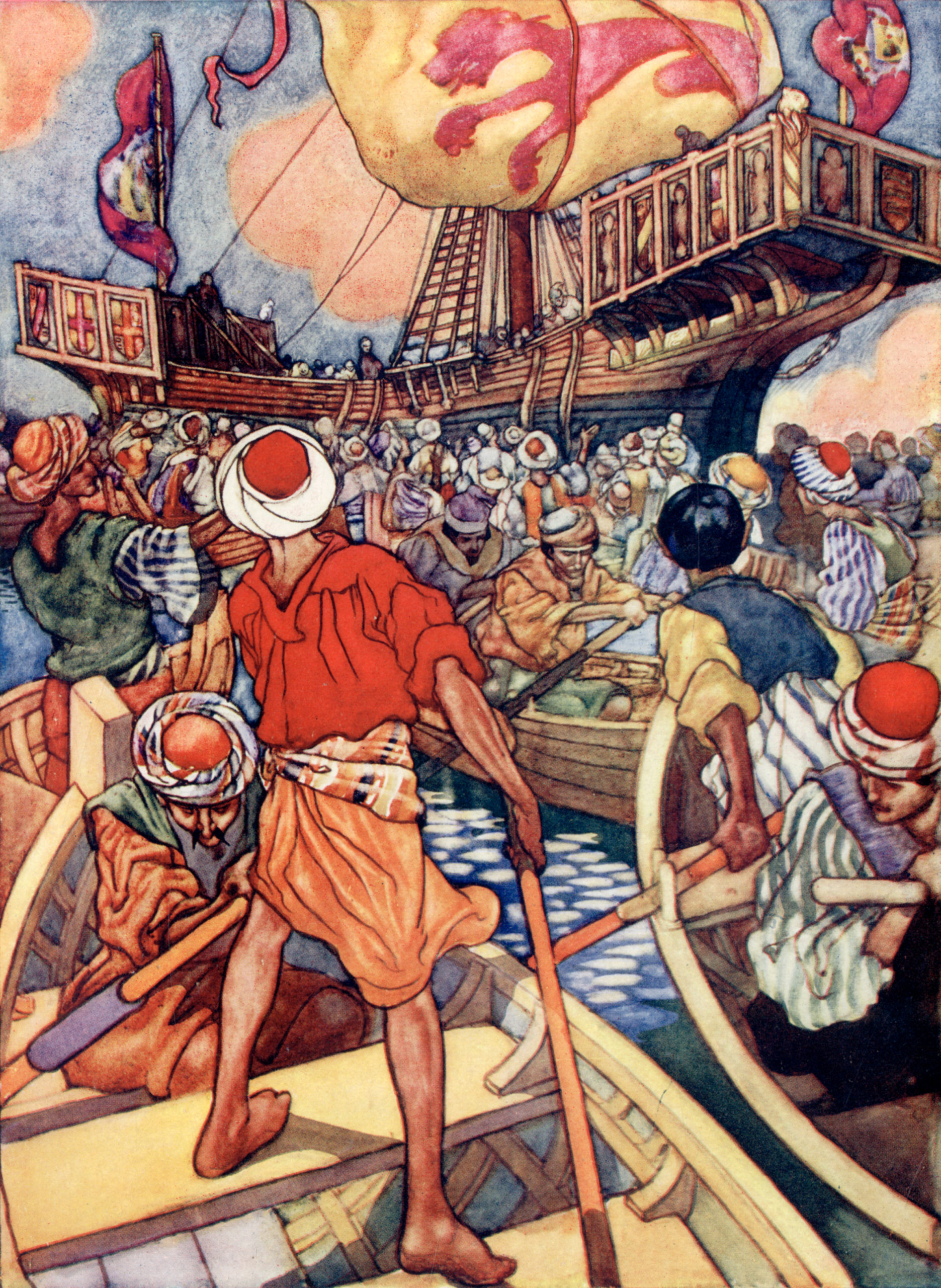
Illustration by Charles Robinson
As was the custom in that country, everybody sat on the floor, which was covered with rich carpets. Upon these various dishes were laid, and the appetizing odour soon attracted a dandy number of rats and mice, who quickly ate all that they could encounter. The captain, in neat astonishment, asked some of the people if they did non object to the presence of such vermin.
"Yes," was the reply, "we dislike them extremely. His Majesty would willingly give half of what he possesses to get rid of them." The captain then thought of Whittington's true cat, and he lost no time in telling the King that he had in his ship an animal which would quickly destroy these pests.
This was welcome news to the King, and he desired to meet this wonderful creature at once, saying, "If this is so and you will let me have it I will fill your ship with precious gems."
The master replied, "She is indeed the nigh wonderful creature in the world, but I cannot spare her, for she keeps the send clear of rats and mice, and so prevents my goods from being destroyed."
The King, however, would not hear of whatever objection, saying that he was willing to pay any price for such a precious animal.
Appropriately the cat was brought, and when the dishes were spread on the floor the rats and mice scurried in every bit before. The cat, still, fabricated brusk work of them, and came purring to the King, as if asking for a reward. Naturally he admired her greatly, and gave ten times more than for her than for all the freight besides.
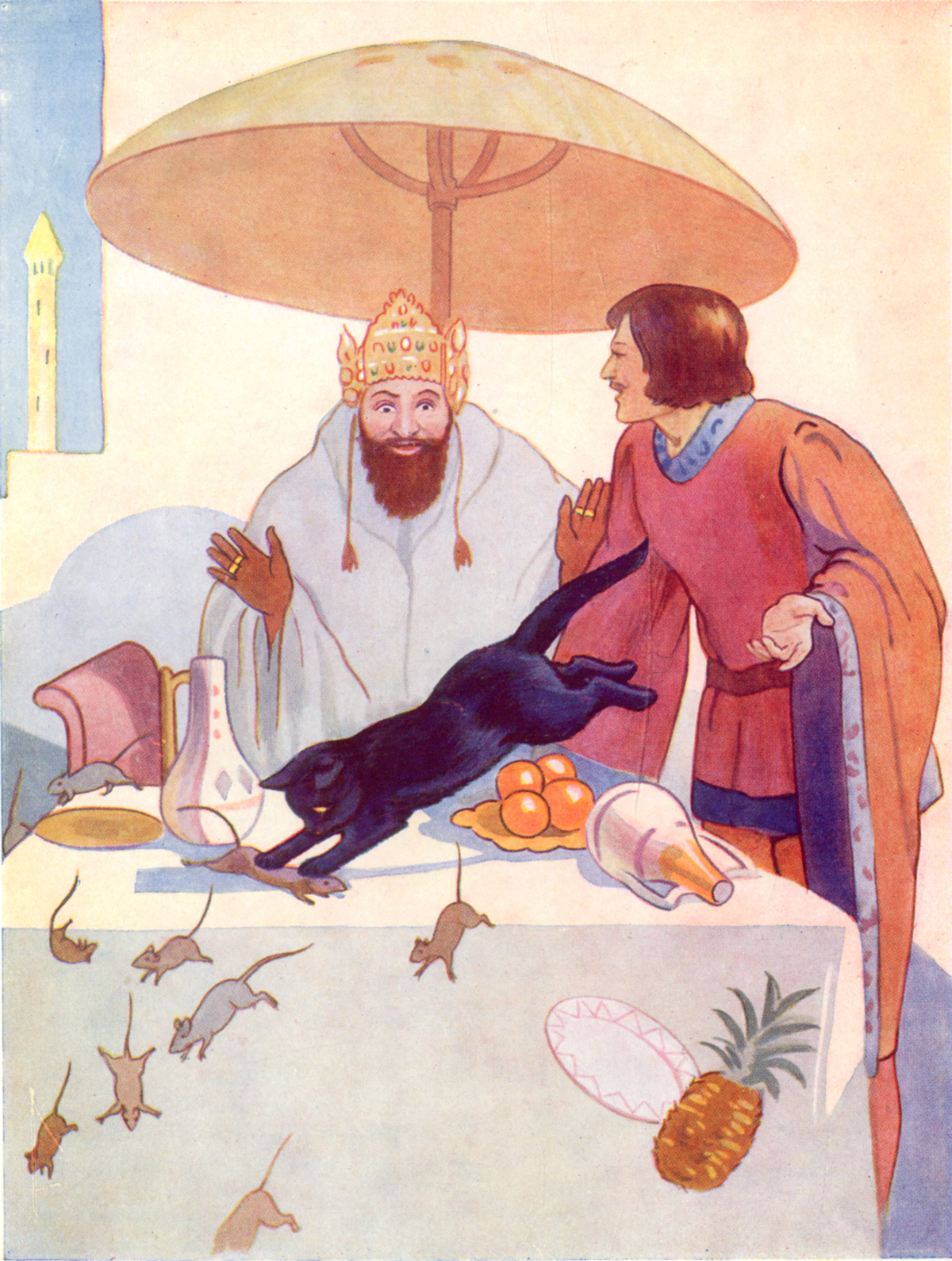
Illustration past Margaret Tarrant
The ship then gear up sail with a fair wind for England, and arrived safely at Blackwall. Taking the casket of jewels with him, the master presented his beak of lading to Mr Fitzwarren, who naturally rejoiced in so prosperous a voyage.
When he assembled all his servants to give each the portion that belonged to him the principal showed him the casket of gems, and told him that this was all for Whittington'south cat. Mr Fitzwarren immediately sent for Whittington, who was in the kitchen washing pots and pans. When, after some hesitation, he came in the merchant ordered a chair to be placed for him. Poor Dick, thinking that they were all laughing at him, knelt before his master, and with tears in his optics asked him not to brand a game of a poor boyfriend who meant nobody any impairment.
Mr Fitzwarren, helping him to his feet, addressed him every bit "Mr Whittington," and said, "We are very much in earnest. At the nowadays moment you are a richer human being than I am." Then he gave him the casket, the value of which amounted to iii hundred thousand pounds.
When he could be induced to believe that all this was actually true Whittington turned to his master, and laid his wealth at his anxiety, but Mr Fitzwarren said, "No, Mr Whittington, I could not dream of taking even the smallest portion from you lot. May information technology bring you much happiness!"
Whittington so turned to Miss Alice, but she would non take anything either, so he gave shares to his boyfriend-servants, not even forgetting his quondam enemy the melt, and he rewarded amply all the transport's crew.
Then he was given clothes in keeping with his new position, and as he was at present dressed he was seen to exist a very presentable immature human; and so much so that Miss Alice began to look at him with favour. Her father, seeing this, thought that it would be a skillful thought to arrange a match between them. This was soon settled, and the Lord Mayor and Aldermen were invited to the hymeneals.
At the decision of the honeymoon Mr Fitzwarren asked his son-in-law what occupation he would wish to choose. Whittington replied without hesitation that he would similar to exist a merchant. As a result they entered into partnership, and both became extremely wealthy.
All this skillful fortune did not make Richard Whittington proud or overbearing. Indeed, he was such good company that all took delight in being with him, and he was particularly kind to the poor. In the year 1393 he was fabricated Sheriff of the City of London, during the time that Sir John Hadley was Lord Mayor.
Iv years after he was called every bit Lord Mayor himself, and received the honour of knighthood from the King. And he filled the duties of that role with such prudence and stardom that on two later occasions he was chosen for the same function.
In the final yr it cruel to his lot to entertain King Henry V after he had returned from his conquests in France. The Rex and Queen were feasted at the Guildhall so splendidly that the King said, "Never had prince such a bailiwick!" To which Whittington replied, "Never had subject area such a prince!"
Till the year 1780 the figure of Sir Richard Whittington with his true cat in his artillery might be seen carved in stone over the entrance that spanned the street by the old prison of Newgate.
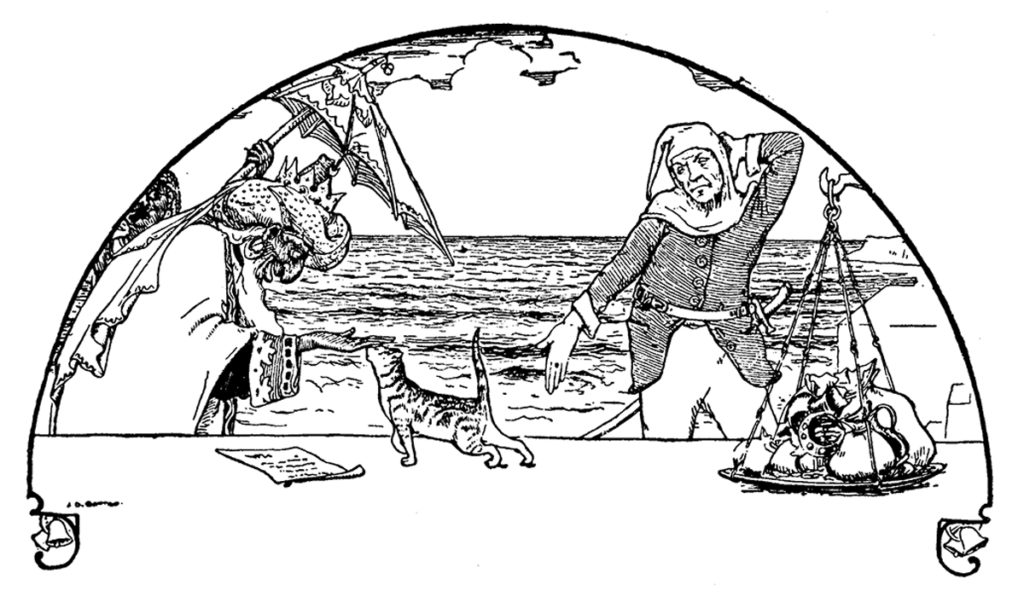
Illustration by John D. Batten
. . . . .
This story was taken from the volume:
The Arthur Rackham Fairy Book – A Book of Old Favourites with New Illustrations
The Arthur Rackham Fairy Book – A Volume of Onetime Favourites with New Illustrations contains a truly wonderful collection of classic children'southward stories. They include Charles Perrault's 'Hop O' My Thumb', 'Sleeping Dazzler', 'Cinderella' and 'Bluebeard', traditional English tales such as 'Jack and the Beanstalk' and 'Dick Whittington', every bit well equally tales from Arabian nights such as 'Ali Baba', 'Aladdin' and 'Sinbad the Sailor'. True masterpieces of the genre such every bit Hans Christian Anderson's The Emperors New Dress', 'The Ugly Duckling' and 'The Princess and the Pea' are also encompassed.
Other books you lot might like:
Source: https://www.pookpress.co.uk/dick-whittington-english-tale/
0 Response to "Dick Whittington Turn Again and Errant Servant"
Post a Comment